
Medical Existential Model
Recovery is about more than getting betterA framework for rediscovering direction, rhythm, and space
Recovery Beyond Getting Better
A medical event affects more than your health
A diagnosis, treatment, surgery, or prolonged recovery can set many things in motion at once. Not only physically, but also emotionally, mentally, relationally, and existentially.
At the same time, life goes on. There are relationships, work, responsibilities, and decisions that do not simply disappear.
The Medical Existential Model brings these different realities together. It helps you understand what is happening, see how the different areas of your life influence one another, and identify what needs attention in order to regain clarity, balance, and direction.
What does the model bring together?
The medical reality
Diagnosis, treatment, rehabilitation, and their consequences form the reality you have to navigate.
What is happening within you
Your body, emotions, thoughts, relationships, and sense of meaning continuously influence one another.
Self-regulation and deep self-care
Moving from overwhelm and disruption towards a clearer awareness of what is happening and what you need.
Finding directions again
Not necessarily returning to how things were, but exploring how you can move forward from the reality you are in now.
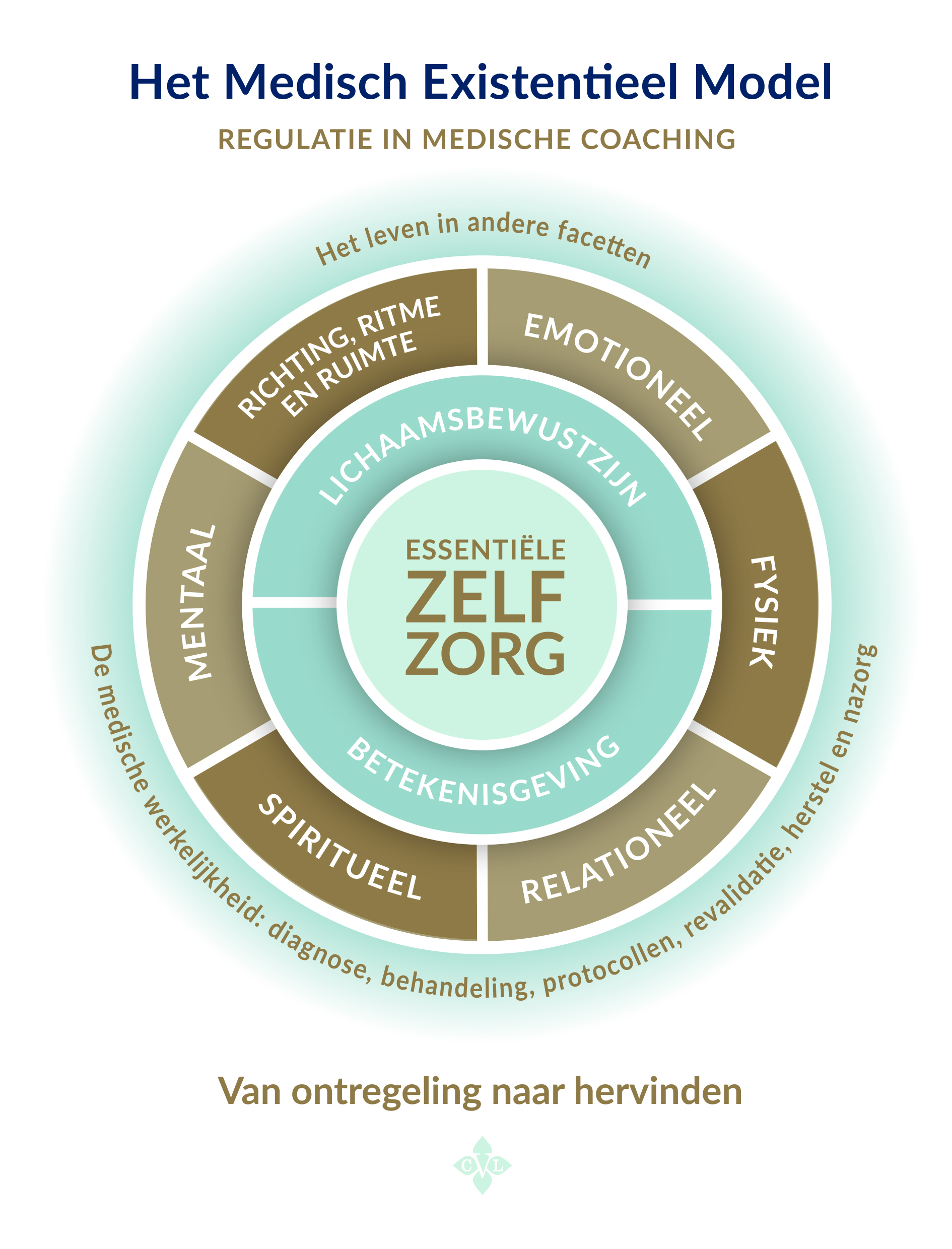
How to read the Medical Existential Model?
The model shows that recovery does not take place in just one area of life. What happens physically can affect emotions, thoughts, relationships, and sense of meaning. Conversely, changes in those areas can also influence how someone experiences their medical reality and day-to-day functioning.
The different elements of the model are therefore not separate from one another. They are constantly interacting and influencing each other.
The different elements of the model therefore do not stand alone. They are constantly influencing and moving with one another.
The medical reality
Diagnosis, treatment, rehabilitation, and aftercare form the medical reality. The model looks at what this means for your daily life, your ability to function, and your future.
The five dimensions of recovery
Physical, emotional, relational, mental, and spiritual/existential, and the way these dimensions influence one another.
Body awareness & meaning-making
Becoming aware of what is happening in your body and inner world, and making sense of a reality that may have changed.
Self-regulation and self-care
Over de beweging van overweldiging en bewustwording naar meer zelfregulatie en passende zelfzorg.
Direction, rhythm, and space
Finding direction again, developing a rhythm that fits your current capacity, and creating space for what is needed.
How the model informs my coaching
The Medical Existential Model is not a fixed step-by-step process. It provides a framework for the coaching by helping us identify what is going on, where disruption is occurring, and what needs attention at that moment.
In my coaching, I use the model as a professional framework for understanding what recovery means in your specific situation. Together, we explore how your changed medical reality affects your capacity, your ability to function, your choices, and your responsibilities, and what may help you move forward from there.
This creates a form of coaching that is not based on how things should be, but on what is true now and what is needed to find renewed direction, rhythm, and space.

What does this mean for your situation?
Everyone's medical circumstances are different. In an introductory conversation, we can explore what you're going through and whether my coaching would be right for you.
 English
 Dutch